
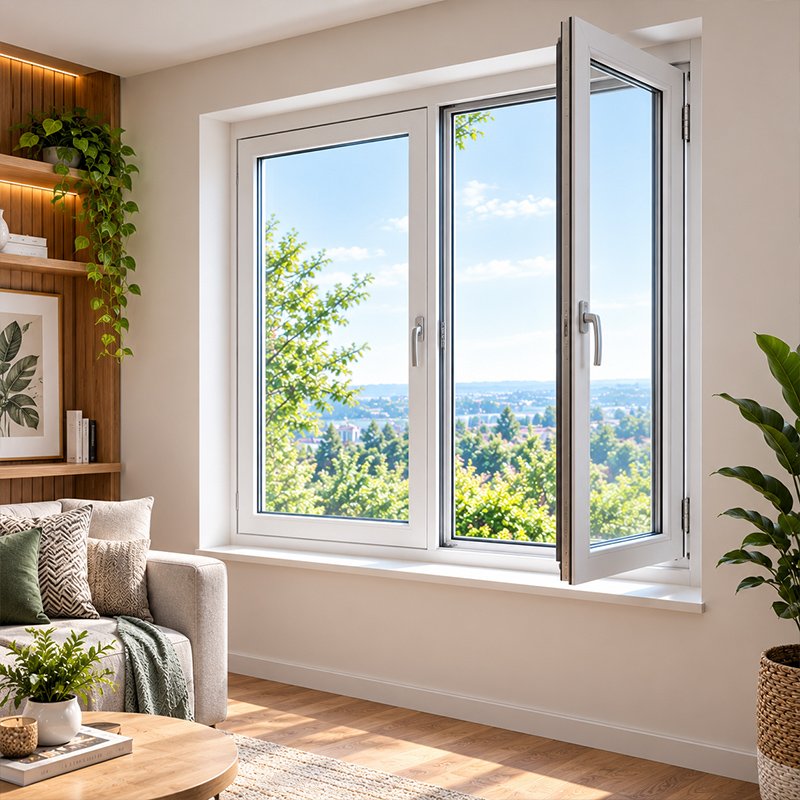
Aluminium is cheaper on day one. Here is what the two materials actually cost you over twenty years in this climate.
The Day-One Price Is Not the Comparison That Matters
An aluminium window quoted against a uPVC window of the same size will usually come in lower. That is real, and for a temporary structure or a shed it may be the right answer. For a house you intend to live in for twenty years, it is the wrong comparison — because the two materials behave completely differently once the first monsoon arrives.
Aluminium is a solid metal section. It conducts heat straight through the frame, it corrodes where the anodising is scratched, and it seals with brush strips that flatten within a few years. uPVC is a multi-chambered profile with air pockets inside it, sealed with EPDM gaskets that stay elastic, and it does not corrode at all.
Heat: A Solid Metal Frame Is a Bridge
Put your hand on an aluminium window frame at 2pm in May. That heat is coming through the frame into the room, and no amount of glass upgrade changes it. The 60mm multi-chambered uPVC profile we fabricate has sealed air chambers running through it, which is why it stays close to room temperature on the same wall.
In an air-conditioned room the effect compounds all day: less heat coming in through the frame, and much less conditioned air leaking out through the seals. Owners of double-glazed uPVC bedrooms in Trichy consistently report the compressor cycling less often.
Rain, Dust and the Seal Around the Sash
The most common complaint we are called about is not broken glass — it is water and dust coming in around an old aluminium slider. Brush seals wear, tracks fill with grit, and the sash no longer presses onto anything.
A uPVC casement compresses onto an EPDM gasket on all four sides, and the frame carries drainage channels that take any water that does get in back out to the outside face. That is why a correctly fitted uPVC casement stays dry through a Northeast monsoon that defeats the aluminium window next to it.
Coastal Sites Settle the Argument
On the Cuddalore coast the question is not really open. Salt air pits aluminium and rusts any steel fixing that is not protected, and the failure shows within about five years. uPVC does not corrode, and the reinforcement is galvanised steel sealed inside the chamber.
For any site within a few kilometres of the sea, we would not quote aluminium even if a customer asked for it.
What Aluminium Still Wins
Honesty matters here. Aluminium takes very slim sightlines on enormous spans — a 4m tall shopfront pane is a job for structural aluminium or steel, not uPVC. It also costs less upfront, which is a real consideration on a large low-budget project.
For residential openings in the sizes people actually build in Perambalur, Trichy, Cuddalore and Kallakurichi, though, uPVC wins on almost every measure that matters over the life of the house.
Want this applied to your own openings? We measure free anywhere in Perambalur, Trichy, Cuddalore and Kallakurichi, and mark a recommended type and glass on every opening before quoting.
Book a Free Site VisitMore uPVC Guides
Questions From This Guide
The follow-up questions readers send us most often after this one.
Call +91 70947 02370Is uPVC more expensive than aluminium?
Usually yes on day one, by a modest margin per square foot. Over twenty years the comparison reverses because uPVC needs no repainting, does not corrode, and keeps sealing — while aluminium seals degrade and coastal corrosion forces replacement.
Do uPVC windows turn yellow in the sun?
Modern lead-free, UV-stabilised profiles do not. Yellowing was a problem with early low-grade PVC and with lead-stabilised profiles, which is exactly why we fabricate with lead-free German-technology sections.
Which is better for soundproofing, uPVC or aluminium?
uPVC, clearly. The multi-chambered frame damps vibration where solid metal transmits it, and the gasket compression around the sash closes the gaps that let noise in around an aluminium slider.
Can uPVC windows take large spans?
Up to about 3 to 4m as coupled units with steel reinforcement, which covers almost all residential openings. Genuinely huge shopfront spans are still aluminium or steel territory.
Tell Us About Your Openings
Send the room count or the number of openings and we will call back with an indicative per-square-foot rate, then book a free site measurement.
Get This Applied to Your Own House
A free site visit turns general advice into a marked-up plan and a written per-square-foot quote.